
Modern Dental Fillings: Durable, Natural-Looking and Safe
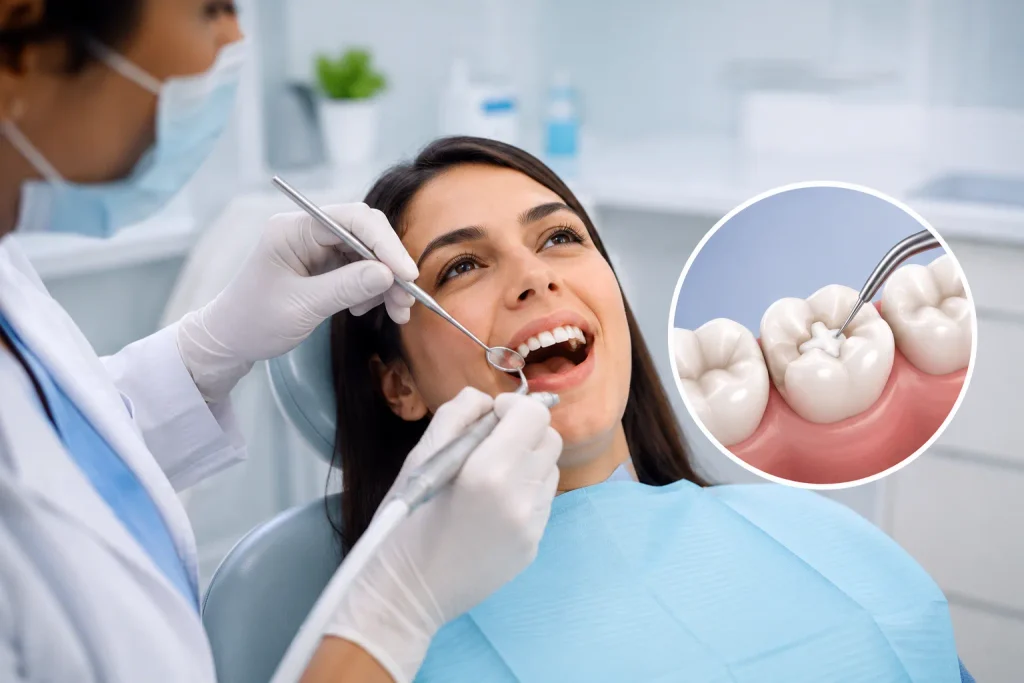
A cavity, a small fracture, or a worn-out old restoration doesn’t necessarily mean the natural look of your smile has to change. Today’s restorative dentistry offers materials that can repair damaged areas of a tooth while aiming to restore both its function and its appearance.
Modern dental fillings , also known as dental restorations, can be made with tooth-colored materials such as composite resin. This allows the restoration to blend visually with your natural enamel and be far less noticeable than the old metal restorations.
For patients who live in Lima and for those considering dental care abroad, understanding the different options is important before deciding which treatment to undergo.
Are all fillings the same? How long do they last? Is resin safe? What happens when the damage is too extensive for a conventional filling? Below, we explain the main options available today and when each one may be used.
What is a dental filling?
A filling is a restoration used to repair an area of the tooth that has lost structure.
One of the most common causes is tooth decay.
When bacteria create a lesion that progressively destroys the enamel and dentin, the dentist can remove the affected tissue and rebuild the area using a restorative material.
Dental fillings can also be used in certain cases to repair:
- Small fractures.
- Tooth wear.
- Deteriorated old restorations.
- Defects on the tooth surface.
- Cervical lesions.
- Some minor cosmetic irregularities.
The exact treatment depends on how much tooth structure has been lost and where the problem is located.
What are tooth-colored dental fillings?
White or tooth-colored fillings are usually made with composite resin.
This material combines a resin matrix with filler particles and comes in different shades to closely match the natural color of each tooth.
The American Dental Association notes that composite restorations can be used on both front and back teeth and offer good durability in small and medium-sized restorations subject to moderate chewing pressure.
For this reason, they are now a common option when patients want to repair a cavity without leaving a highly visible metal restoration.
How is a resin filling placed?
The procedure may vary slightly depending on the tooth and the extent of the lesion, but it generally follows several steps.
1. Tooth evaluation
The dentist examines the area and determines whether a direct restoration is sufficient.
In some cases, X-rays may be needed to assess the depth of a cavity or rule out more extensive involvement.
2. Removal of the affected tissue
When decay is present, the damaged tooth tissue is carefully removed.
The goal is to preserve as much healthy structure as possible.
3. Tooth preparation
Before the resin is placed, the surface is conditioned to promote adhesion of the restorative material.
One important feature of modern composites is precisely their ability to bond to tooth tissue through adhesive systems.
4. Resin placement
The material is usually added in small layers.
Each layer can be hardened with a special curing light before moving on to the next.
5. Bite adjustment
Once the tooth’s anatomy has been rebuilt, the dentist checks that the restoration does not interfere with your bite.
6. Polishing
Finally, the restoration is polished to achieve a smooth surface and an appearance that blends with the rest of the tooth.
Do modern fillings look natural?
One of the main advantages of resin is its cosmetic result.
The dentist can choose from different shades to closely match the color of your enamel.
This can be especially important for teeth that are visible when you speak or smile.
In addition to color, the dentist can recreate details related to:
- Tooth shape.
- Edges.
- Surface texture.
- Contact points with neighboring teeth.
As a result, certain small restorations can also contribute to a conservative smile restoration without having to go straight to more extensive treatments.
What is the difference between a “curación dental” and a filling?
In everyday use, both terms usually refer to the same type of procedure.
In Peru, it’s common to hear expressions like “curación dental” or “curación con resina,” while in other countries terms such as “empaste,” “obturación,” or filling are used more often.
So if an international patient asks about a dental filling and a Peruvian patient asks about a “curación,” both may be referring to the restoration of a cavity.
However, the exact procedure must be determined after evaluating the tooth.
When is resin a good option?
Resin restorations can be used in many situations, but not every lesion should be treated with the same material.
They may be especially appropriate for:
- Small or moderate cavities.
- Restorations visible when smiling.
- Small fractures.
- Replacing certain deteriorated restorations.
- Conservative shape corrections.
- Rebuilding some tooth edges.
The choice also depends on how much tooth structure remains and the forces the tooth is subjected to.
The ADA notes that factors such as the size and location of the cavity, aesthetics, expected longevity, and cost can influence the choice of restorative material.
How long does a resin filling last?
There is no exact lifespan that applies to every patient.
Composite restorations have improved considerably, and the ADA notes that these materials show increasingly higher survival and reliability rates.
However, no filling should be considered permanent.
Its lifespan may depend on:
- The size of the restoration.
- The tooth treated.
- The quality of oral hygiene.
- The presence of new cavities.
- Bite force.
- Bruxism.
- Eating habits.
- Placement technique.
- The amount of remaining tooth structure.
A small restoration may perform differently from one that rebuilds a large part of a molar.
That’s why it’s important to have your fillings checked regularly during dental checkups.
Is dental resin strong?
Yes, when used for the right indications.
Modern resins offer good strength for many front and back restorations. However, this doesn’t mean they are always the best option for extremely large reconstructions.
When a significant part of the tooth has been lost, the dentist may consider other solutions that provide a different kind of protection.
The goal is not simply to “fill the space,” but to select the restoration best suited to the amount of remaining structure and the chewing forces it will have to withstand.
What other materials are there besides resin?
Dental fillings can be made from different materials.
The ADA’s classification of direct restorations includes amalgam, resin composite, glass ionomer, and resin-modified glass ionomer.
Each material has its own characteristics.
Composite resin
It is one of the most widely used options when aesthetics matter.
Its main advantage is that it can closely match the color of the tooth.
Glass ionomer
It can be used for certain clinical indications, especially where chewing forces are not excessive.
It usually doesn’t offer the same translucent aesthetics as composite, nor is it indicated in the same way for large areas under load.
Dental amalgam
Amalgam is a metal restoration that has been used for more than a century.
Although many patients today prefer tooth-colored materials, it remains a recognized restorative option thanks to its strength and durability in certain situations. The ADA still considers it a safe and effective restorative material.
Its main cosmetic drawback is that it doesn’t reproduce the tooth’s natural color.
What happens when a filling is no longer enough?
Not every damaged tooth can be rebuilt with a direct resin restoration.
When there is extensive loss of tooth tissue, other procedures may be considered.
These include:
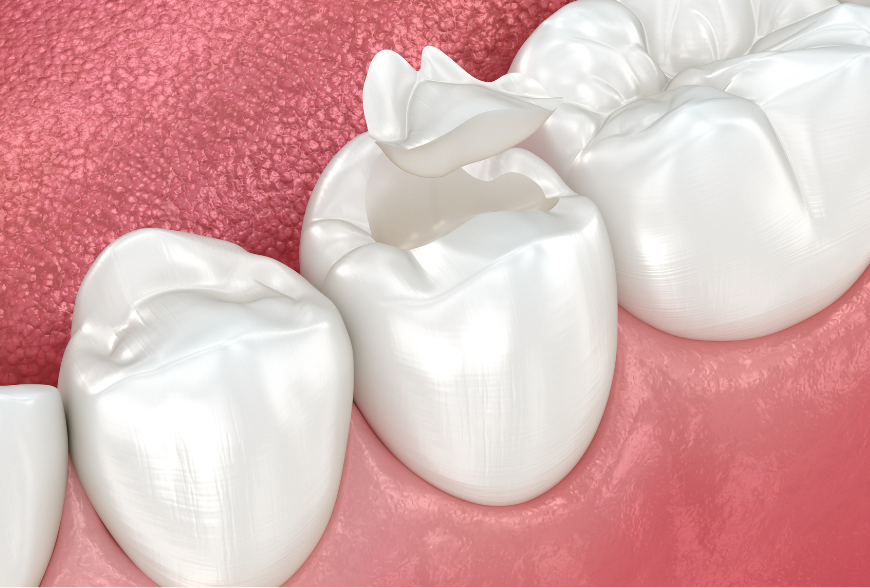
Inlays and onlays
These are indirect restorations fabricated outside the mouth or with digital systems.
They make it possible to rebuild larger areas of certain teeth while preserving part of the natural structure.
They can be made from materials such as ceramic and other restorative materials.
Dental crowns
When a large part of the structure has been lost or the tooth needs more protection, a dental crown may be considered.
The crown covers a considerable portion of the tooth and aims to restore its shape, strength, and function.
Root canal treatment
If the lesion has reached the dental pulp, a filling alone may not be enough.
In some cases, a root canal may be needed before rebuilding the tooth.
That’s why treating a cavity while it’s still small usually allows for more conservative treatment.
Filling or dental crown?
The answer depends on how much healthy tissue remains.
A filling is usually used when there is enough tooth structure to properly support the restoration.
A crown may be considered when the damage is significant and the tooth needs more extensive coverage.
Trying to fix very large tooth loss simply by adding more resin isn’t always the best long-term option.
The decision should be made after a clinical and radiographic evaluation of the tooth.
Dental fillings and cosmetic smile restoration
Resins aren’t used only to treat cavities.
In certain circumstances, they can also be part of conservative smile restoration procedures.
For example, they can be used to:
- Rebuild a fractured tooth edge.
- Correct small shape defects.
- Close some small gaps.
- Repair visible restorations.
- Improve the appearance of certain worn areas.
However, not every cosmetic concern can be solved with fillings.
When a patient wants to significantly change the color, size, position, or proportions of several teeth, options such as teeth whitening, veneers, orthodontics, or other smile design treatments may be considered.
Can I replace my metal fillings with resin?
Replacing old restorations can be evaluated, but not all of them need to be removed just because they’re metal.
If a restoration is clinically sound and shows no decay, fractures, or other problems, the dentist should weigh the benefits and risks of replacing it.
Removing a restoration also means working on the tooth again.
That’s why the decision should be made on an individual basis rather than simply assuming that every old filling needs to be replaced.
If the goal is mainly cosmetic, the dentist can explain the different options before you make a decision.
How do you know if a filling needs to be replaced?
Over time, restorations can wear down.
It’s a good idea to schedule a checkup if you notice:
- A fracture in part of the filling.
- Sensitivity that wasn’t there before.
- Pain when chewing.
- A noticeable color change around the restoration.
- A rough or irregular edge.
- Loss of part of the material.
- Food constantly getting stuck in the same spot.
Not all of these symptoms necessarily mean the restoration must be replaced.
An evaluation helps determine what’s going on.
Are dental fillings safe?
The restorative materials used in dentistry have specific indications and should be selected according to the characteristics of the patient and the tooth.
In the case of composites, the ADA recognizes resins as restorative materials widely used for direct restorations and highlights their progress in terms of survival and reliability.
What matters is that the dentist assesses which material is appropriate for each situation.
The choice shouldn’t be based solely on one option being “more modern,” but on clinical, functional, and aesthetic factors.
Do fillings change color?
Composite restorations can discolor or stain over time.
This depends on factors such as:
- Diet.
- Frequent coffee or tea consumption.
- Smoking.
- Oral hygiene.
- Time elapsed.
- Location of the restoration.
Resin also doesn’t respond to teeth whitening in exactly the same way as natural enamel.
So if you’re considering teeth whitening and have visible restorations on your front teeth, it’s best to discuss it with your dentist beforehand.
It may be necessary to plan the order of treatments to achieve better aesthetic integration.
What if I grind my teeth?
Bruxism can increase the forces placed on both teeth and restorations.
A person who clenches or grinds their teeth may be at greater risk of:
- Fractures.
- Wear.
- Chipping of restorations.
- Sensitivity.
- Overloading of certain teeth.
If there are signs of bruxism, the dentist should take them into account before performing an extensive restoration.
For some patients, a night guard may also be recommended after certain restorative treatments are completed.
Can I get several fillings during a trip to Peru?
In many cases, yes, although it depends on the number of teeth affected and the complexity of each treatment.
Patients seeking dental care abroad often try to schedule several procedures within a limited stay.
If you’re traveling to Lima and know you need several restorations, it’s best to have an evaluation at the start of your trip.
This makes it possible to:
- Identify which teeth actually need treatment.
- Determine which ones can be restored with resin.
- Detect whether any lesion requires a root canal, crown, or other procedure.
- Schedule several appointments if needed.
- Set aside time for a follow-up visit before you fly home.
It’s not advisable to assume that all cavities can be treated in a single visit without first getting a diagnosis.
Dental care abroad: what should you ask before treatment?
If you’re considering dental care abroad, it’s wise to request clear information before you begin.
You can ask:
- What material will be used?
- Why is that material indicated in my case?
- How much tooth tissue is affected?
- Does the tooth only need a restoration?
- Is there a risk of needing a root canal?
- What aftercare should I follow?
- Do I need a follow-up visit before I travel?
- What happens if I have discomfort after returning to my home country?
It can also be helpful to request a summary of the treatments performed to share with your regular dentist.
How much do dental fillings cost in Peru?
The price of a dental filling or restoration can vary depending on:
- The size of the lesion.
- The tooth affected.
- The number of surfaces that need to be restored.
- The material used.
- The need for additional tests or imaging.
- The complexity of the procedure.
For this reason, not all fillings necessarily cost the same.
In addition, comparing cost alone may not be enough.
For international patients, it’s worth reviewing what the treatment includes, what material will be used, and what follow-up will be available after leaving Peru.
Frequently asked questions about dental fillings
How long does a dental filling last?
There is no guaranteed number of years. Lifespan depends on the size, material, location, bite, hygiene, and habits of the patient. Restorations should be checked regularly.
Can resin be used on back teeth?
Yes. Composites can be used on both front and back teeth when clinical conditions are appropriate.
Does getting a dental filling hurt?
When needed, local anesthesia can be used to make the procedure more comfortable. Afterward, there may be temporary sensitivity depending on the depth of the restoration.
Is resin or a crown better?
They are not equivalent treatments. Resin may be sufficient for small or moderate damage, while a crown may be indicated when there is more extensive loss of structure.
Can I eat after a resin restoration?
Instructions may vary depending on the procedure and whether anesthesia was used. It’s best to follow your dentist’s specific recommendations before eating or chewing on the treated area.
Can I whiten a tooth that has resin?
Whitening mainly changes the color of natural tooth tissue and may not change the color of an existing restoration. If you have visible fillings, it’s a good idea to plan your cosmetic treatment with your dentist.
Does a cavity always need a filling?
Not all lesions are at the same stage. Some early lesions can be managed differently, while others that have already formed a cavity require a restoration. The diagnosis determines the appropriate treatment.
A small restoration can prevent a more complex treatment
A cavity that progresses can destroy more and more of the tooth’s structure.
When detected early, certain cases can be resolved with conservative dental fillings made with materials such as tooth-colored resin.
In addition to restoring function, today’s materials allow for discreet results that can be integrated into a broader smile restoration when there are other cosmetic needs.
If you live in Miraflores or San Isidro, or you’re considering dental care abroad during a visit to Lima, an evaluation can help you determine whether you need a simple restoration or a different treatment.
The goal shouldn’t be merely to repair a cavity, but to preserve as much natural structure as possible and select the right restoration to keep the tooth functional and healthy for the long term.